Executive Summary
After February 24, 2022, Ukrainians became the largest group of forcibly displaced people in Europe since World War II, and their integration has gradually shifted from an “emergency response” to a long-term societal task.
According to the United Nations High Commissioner for Refugees, as of December 2025, there were 5.86 million Ukrainian refugees worldwide (approximately 5.3 million in Europe), as well as 3.7 million internally displaced persons within Ukraine. At the same time, barriers to access to housing, decent employment, healthcare, education, and social protection have been increasing in host countries over time :contentReference[oaicite:0]{index=0}.

Displacement of Ukrainians after 2022
Three receiving “policy models” differ significantly and shape integration outcomes in different ways:
- European Union: relies on a mass legal regime of temporary protection that provides broad rights (employment, education, healthcare, etc.) and relative legal certainty until 2027. However, practical integration is highly uneven across member states and constrained by shortages of housing, childcare, and recognition of qualifications.
- United States: uses humanitarian parole with private sponsorship (Uniting for Ukraine) and Temporary Protected Status (TPS), enabling rapid entry and employment, but creating dependence on sponsors/local resources and vulnerability to political changes and status uncertainty.
- Canada: introduced the large-scale CUAET program with open work/study permits and transitional support, but for many the key barrier remains the temporary nature of the status and high costs of housing and education.
Empirical data show high labor market participation among Ukrainians where administrative barriers are low and childcare services are available, but also large-scale deskilling and gaps in job quality compared to host populations. According to UNHCR analysis based on 6,000+ observations, 57% of Ukrainian refugees in Europe are employed, but they lag behind host country citizens by 22 percentage points, and 60% work below their qualifications. Potential GDP gains from improved integration are estimated at up to +0.7 percentage points annually :contentReference[oaicite:1]{index=1}.
---Migration Flows and Main Host Countries
In 2025, ongoing hostilities and attacks on critical infrastructure caused new waves of displacement, while the duration of the war increased household vulnerability in host countries in terms of housing, employment, healthcare, education, and social protection.
Distribution of Ukrainian refugees
---EU: Temporary Protection as a Mass Channel
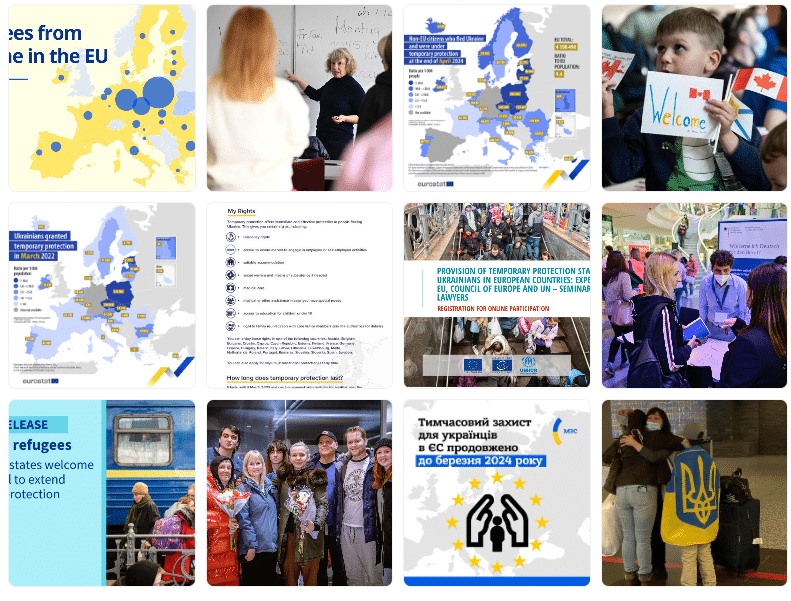
According to Eurostat, as of January 31, 2026, 4.38 million non-EU citizens fleeing Ukraine were under temporary protection in the EU, with the highest numbers in Germany, Poland, and Czechia :contentReference[oaicite:2]{index=2}.
Additional indicators show the highest number per 1,000 population in Czechia, Poland, and Slovakia, reflecting pressure on housing, education, and healthcare systems.
The EU has issued nearly 6.9 million temporary protection decisions since 2022, though some individuals have returned or moved between countries.
---Canada: CUAET
As of August 31, 2025:
- 1,189,320 applications received
- 813,142 approved
- 305,380 arrivals to Canada
United States: Humanitarian Parole and TPS
Between February 24, 2022, and September 30, 2024, approximately 259,000 individuals from Ukraine were granted parole, including about 230,000 through Uniting for Ukraine.
TPS for Ukraine remains in effect until October 19, 2026.
---Legal Pathways and Integration Effects
Integration depends on:
- Legal access frameworks (rights to live/work)
- System capacity (housing, childcare, recognition of qualifications)
Housing
Housing is the main bottleneck in all systems.
In the EU, housing shortages limit long-term integration. In Canada, affordability is a major issue. In the US, housing depends heavily on sponsors, creating uneven outcomes.
---Employment
In Europe, 57% are employed, but 60% work below their qualifications.
In Canada, 80.1% are employed, but only 25.7% work in their original field.
---Education
In Europe, up to ~78% of children are enrolled in formal education, but systems face capacity constraints.
In the US and Canada, access varies depending on local conditions.
---Language
Language is a key integration factor, but access to courses is uneven.
---Health
Healthcare is generally available, but barriers include language and system overload.
---Social Networks and Discrimination
Social networks are crucial for integration, while discrimination (including against Roma refugees) remains an issue.
---Policy Frameworks
EU uses funding tools such as CARE and FAST-CARE.
US relies on federal agencies and local networks.
Canada combines federal policy with provincial service systems.
---Main Findings
- Early employment access
- Language training
- Childcare access
- Recognition of qualifications
These factors are key for successful integration.
---Conclusion
The integration of Ukrainian refugees is a long-term structural challenge requiring legal access, system capacity, and sustained policy efforts.
This experience provides critical insights into how modern migration systems operate under pressure and how they may evolve in future crises.