Easter in Ukraine: A Living Tradition Forged Between Faith, War, and Memory
In Ukraine, Easter does not begin at sunrise. It begins in the dark.
Before dawn, people gather outside churches holding candles that flicker in the cold air. The silence breaks with a phrase repeated for centuries: “Christ is Risen.” This is not just a greeting. It is a declaration — one that has survived empires, repression, and war.
To understand Easter in Ukraine is to understand something essential about the country itself: a culture shaped by continuity, adaptation, and quiet resilience. It is a tradition that binds the sacred to the everyday and the historical to the intimate.

A Holiday Older Than Its Faith
Long before Christianity arrived in Kyiv in 988, communities across these lands marked the arrival of spring with rituals of renewal. Water was associated with cleansing. Fire with protection. Seasonal gatherings with fertility, courtship, and the reawakening of life.
When Christianity took hold, it did not erase these older layers. It absorbed them. What emerged was a distinctively Ukrainian Easter: fully Christian in theology, yet still carrying echoes of an older agrarian world where the coming of spring meant survival, abundance, and hope.

The Rituals That Structure Life
The Easter service is the spiritual center of the holiday, but in Ukraine the ritual does not end at the church doors. It spills into kitchens, courtyards, family tables, village squares, and public memory.
Families prepare baskets filled with bread, eggs, meat, salt, horseradish, and other foods. Each item has meaning. Bread represents blessing and wholeness. Eggs suggest life and rebirth. Salt preserves. Horseradish stands for strength. Together they turn the Easter basket into more than a meal: it becomes a compact image of the household itself.

After the blessing, families return home and share the food. In many places, part of it is also given away. Charity is not secondary to the ritual. It is embedded within it, a reminder that celebration has always carried a social obligation.
Symbols That Speak Without Words
Few objects are as closely tied to Ukrainian Easter as the pysanka — the decorated egg whose patterns carry layers of meaning. These are not merely ornamental designs. They belong to a visual language of continuity, protection, the sun, the harvest, and life itself.


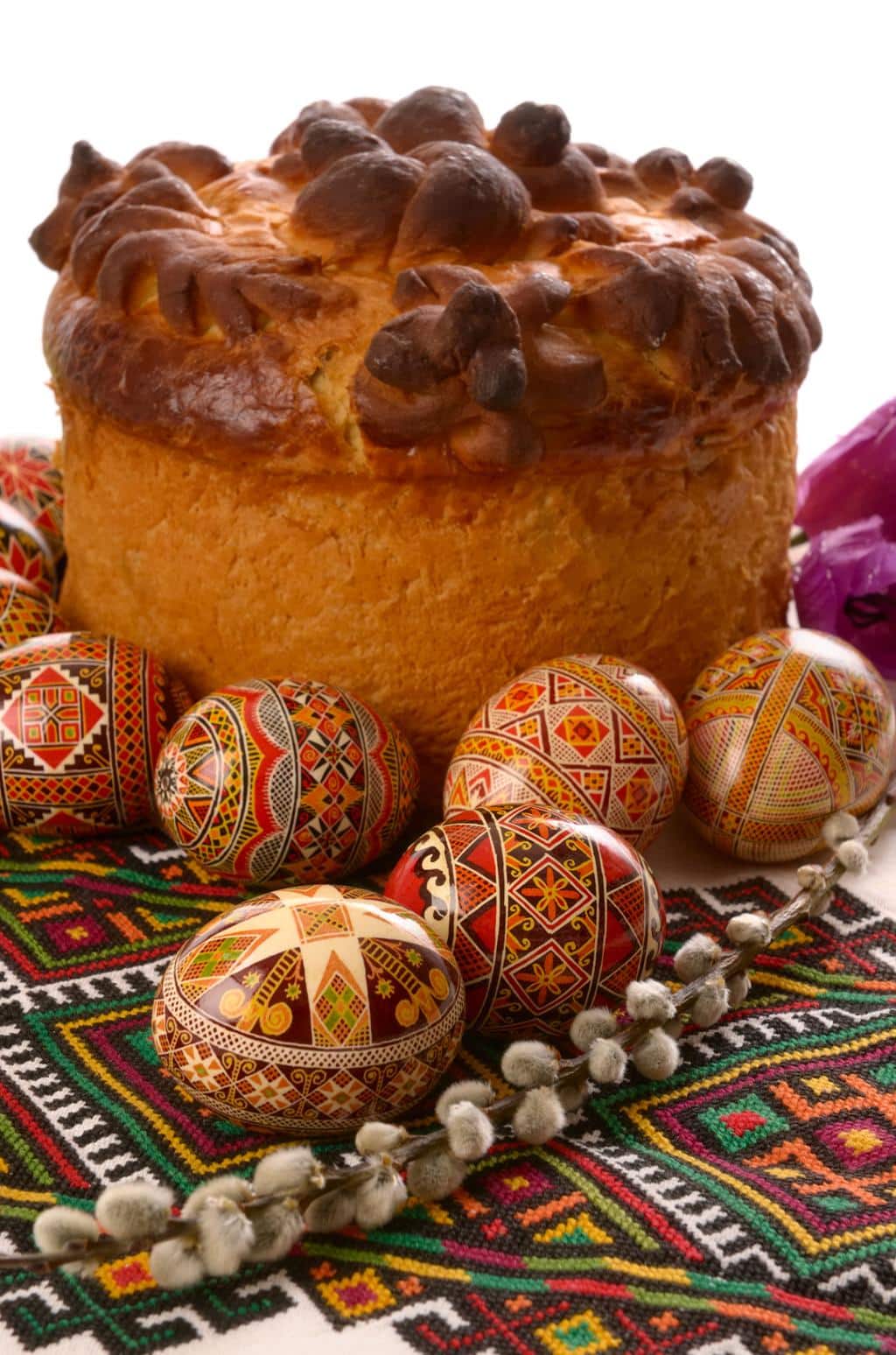

The same symbolic density is present in other Easter elements as well: bread, candles, garlic, salt, and water. In Ukrainian tradition, the sacred is rarely abstract. It is touched, tasted, carried, blessed, and shared.
A Country of Many Easters
There is no single Ukrainian Easter. The holiday changes from one region to another, shaped by geography, local history, and community memory.
In the Carpathians, rituals can be highly elaborate and symbolically rich. In Polissya, traditions connected to water and protection are especially visible. In Galicia, Easter songs and circle dances remain central to the season. Elsewhere, communal gatherings and family-centered meals define the celebration.


These differences do not divide the tradition. They deepen it. Easter in Ukraine is best understood not as a single fixed model, but as a family of related customs held together by common meaning.
Survival Through the Soviet Era
Under Soviet rule, religion was pushed out of public life. Churches were controlled, closed, or repurposed. Religious holidays did not disappear, but they were forced inward.


Easter survived in kitchens, in whispered greetings, in family recipes, in painted eggs, in the passing down of gestures children learned by watching adults. It remained what many Ukrainian traditions have long been: resilient precisely because they are lived, not merely performed.

Food as Ritual, Meal as Memory
In Ukraine, Easter food is not simply festive cuisine. It marks the end of fasting, the return of abundance, and the restoration of joy. The meal is ceremonial not because it is extravagant, but because it is meaningful.
To share Easter food is to affirm belonging: to a family, to a place, to a rhythm of life older than modern politics. That is why the holiday remains so emotionally powerful. It joins memory to the table.
Why It Matters Today
In contemporary Ukraine, especially in a time shaped by war, Easter carries additional force. It is not only about religion. It is about continuity. About keeping hold of something human and deeply rooted when history becomes violent and unstable.

For international readers, Ukrainian Easter offers a rare way to see the country beyond the headlines. It reveals how memory is preserved not only in archives or monuments, but in ritual acts repeated year after year: lighting a candle, blessing a basket, painting an egg, sharing bread at the table.