Since 2022, Oleshky has lived through three kinds of destruction: war, water, and silence. And the worst thing about silence is that, from a distance, it can begin to look like peace.
Oleshky is one of those places that rarely enters the international imagination on its own. It is usually mentioned as a point on the map near Kherson, or as part of a military report, or in the shadow of a larger catastrophe. But for the people who lived there, it was not a footnote. It was a town with gardens, bus stops, summer dust, quiet streets, family kitchens, a rhythm of ordinary life that seemed too small to be noticed by history. Then history arrived anyway.
Russian occupation came with the blunt force familiar to much of southern Ukraine in 2022: checkpoints, fear, uncertainty, the slow replacement of civic life with coercion. Occupation is not only about soldiers and flags. It is also about the rearranging of reality. The town you knew is still physically there, but it no longer belongs to its residents in the same way. Every errand becomes a calculation. Every silence becomes suspicious. Every stranger may be dangerous. People learn to lower their voices. They learn which roads to avoid. They learn not to ask too many questions. They learn how quickly a hometown can stop feeling like home.
Then, in June 2023, the water came.
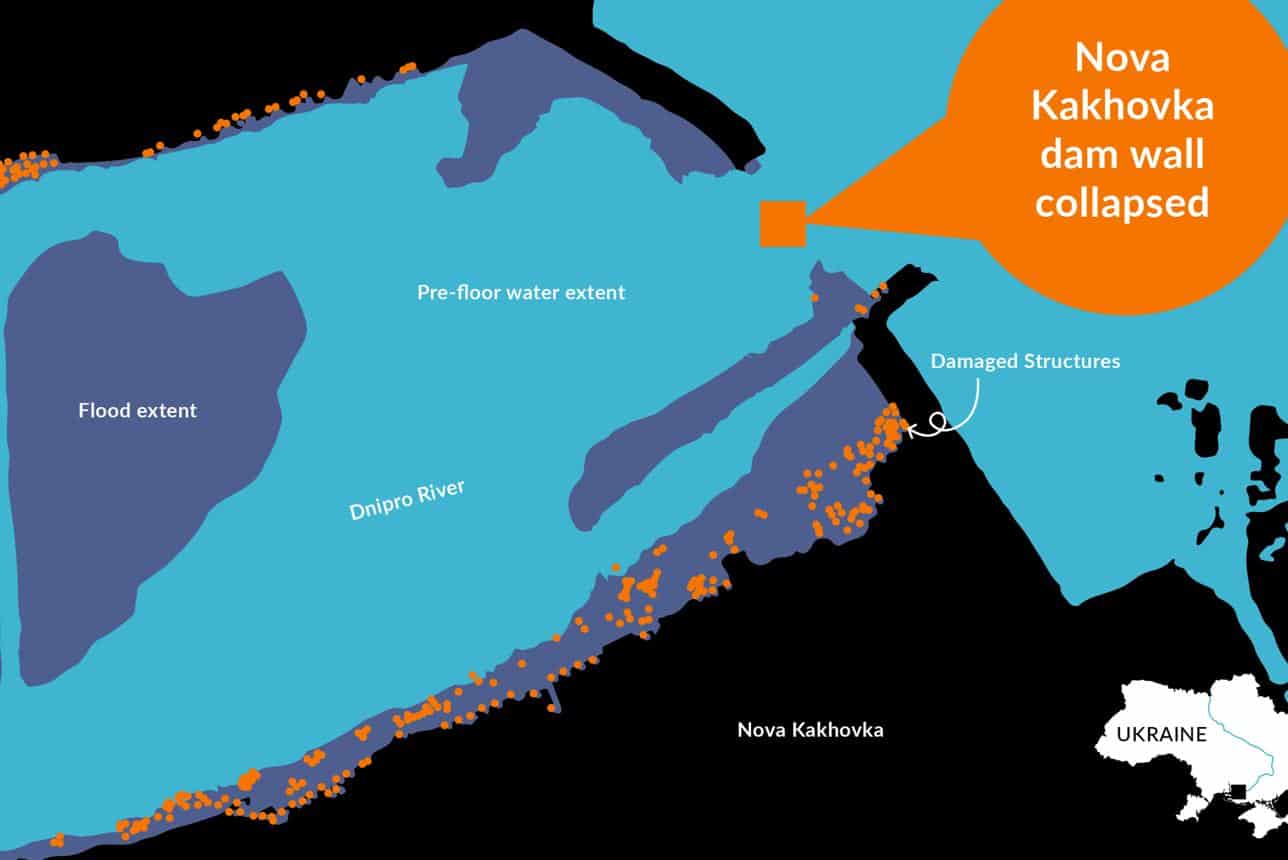
When the Kakhovka dam was destroyed, the lower Dnipro basin turned into a geography of panic. The left bank suffered especially badly, and Oleshky — low, exposed, trapped under occupation — became one of the names that survivors, journalists, volunteers, and rights monitors repeated with particular grief. In a war already full of images too painful to process, this one still managed to shock: people on rooftops, flooded streets where streets should not have been rivers, elderly residents waiting for rescue where rescue did not come fast enough, families trying to navigate not just disaster but occupation in the middle of disaster.
“"Our house was carried away."” Survivor testimony reported by Reuters after the flood
That sentence contains more than the loss of property. It contains the violence of seeing the fixed world become movable. A home is meant to anchor a person in time. In Oleshky, people watched homes become debris. The flood did not simply damage walls; it erased the basic contract between people and place. Doors, sheds, household things, gardens cultivated over years — all of it was lifted, soaked, broken, dragged away. For some, the catastrophe lasted hours. For others, it continued for weeks, because water is not just a moment when it enters. It is what it leaves behind: rot, mold, contaminated wells, wrecked belongings, disease, and the feeling that the floor of life itself has turned unstable.
The horror in Oleshky was sharpened by the fact that this was not a natural disaster unfolding in an open and functioning civic space. It happened under occupation. That changes everything. It changes evacuation. It changes information. It changes who can enter, who can help, who can be counted among the living, and who disappears in the gap between testimony and official acknowledgment. In free cities, catastrophe is measured by sirens, emergency crews, and public records. In occupied cities, catastrophe is often measured by absence: absent rescue, absent medicine, absent transparency, absent names.
Survivors and rights monitors described a town where many residents were left to rely on each other, on improvised boats, on desperate calls, on luck. Some accounts spoke of people being blocked from leaving. Others described the confiscation of boats or the obstruction of self-rescue. To be trapped by floodwater is one thing. To be trapped by floodwater while armed men control the roads, the river, and the story is another. The result was not only physical devastation but moral devastation — the experience of being abandoned while still visible.
A former resident later told investigators that when Oleshky began to flood, the occupation authorities "did not help anyone."“ Paraphrased from OSCE reporting on witness testimony
There are tragedies that explode loudly and tragedies that settle slowly into the bones of a place. Oleshky has endured both. The dramatic image is the flood. The slower one is what came after: a city drained of people, of trade, of confidence, of ordinary continuity. Long after the headlines moved on, reports kept emerging of shortages, blocked access, disappearing public life, and a population reduced to a fraction of what it once had been. The town was described not as recovering, but as withering. Not rebuilding, but surviving in fragments.
This is what makes Oleshky important to understand. Its crisis is not a single event. It is a chain. First, war. Then occupation. Then flood. Then neglect. Then blockade-like conditions. Then the erosion of memory abroad, because distant suffering is always at risk of becoming abstract. But nothing about Oleshky is abstract for the people who remain there or for those who escaped and still measure time by before and after.
Before the full-scale invasion, Oleshky was not famous. That was part of his dignity. Most towns deserve the right to be known only to their residents, their relatives, their neighboring communities, and the occasional traveler. They deserve to be ordinary. War robs places of that privacy. It drags them into the world's vocabulary through destruction. Oleshky has become known not for what it built, but for what was done to it.
And yet even in that damaged landscape, the town remains legible through the voices of people who refuse to let it disappear into statistics. One woman spoke of life shrinking under occupation long before the flood. Another described the chaos after the dam destruction not as a single shock but as a continuation of fear, only wetter, colder, and more final. Others, in interviews and witness accounts, returned again and again to the same feeling: not simply that they had lost things, but that they had been left alone with the loss.
Residents of the flooded left bank were trapped, while officials and witnesses said many were blocked from leaving or forced to survive on their own. Paraphrased from reporting by Reuters, rights groups, and Ukrainian media
The situation now, in 2026, is not the dramatic crest of floodwater but something in some ways harder to photograph: depletion. Reports from this year describe Oleshky as a place where the remaining civilian population faces acute hardship, including shortages of food, medicine, heating, and safe everyday conditions. A town can die in more than one way. It can die in an explosion. It can die in a flood. Or it can be made to die slowly, through attrition, through the organized removal of everything that allows ordinary life to continue. Oleshky has been pushed into that third condition as well.
In the language of politics, these are humanitarian indicators. In the language of lived experience, they are much simpler. They mean an old person cannot get pills. They mean a family cannot repair a ruined room. They mean winter enters too easily. They mean hunger becomes ordinary enough to stop sounding dramatic. They mean the town's children, if they are still there, grow up learning that danger is permanent and comfort is temporary. They mean the future becomes difficult to imagine in local terms.
This is why Oleshky matters beyond Oleshky. It is a concentrated example of what modern war does when occupation, environmental destruction, and civilian vulnerability are forced into the same place. It shows how a town can be attacked not only militarily but existentially. It shows that the destruction of infrastructure is never merely technical. A dam is concrete, but its collapse enters kitchens, bedrooms, cemeteries, schools, photographs, family albums, and the stories people try to tell later without breaking down.
The crisis in Oleshky is also a challenge to memory. The world is always tempted to move on from places it cannot easily fix. But there are cities and towns whose suffering becomes clearer, not smaller, with time. Oleshky is one of them. The first tragedy was the invasion. The second was submergence. The third is the risk that this layered violence will be remembered only in fragments: one article about flooding, one report about occupation, one statistic about displacement, one forgotten map.
Oleshky deserves to be seen whole. As a Ukrainian town occupied in war. As a flooded town abandoned in catastrophe. As a wounded town still trapped in the long afterlife of both. And most of all, as a place where civilians were not merely caught between armies, but forced to endure the collapse of every ordinary system that makes civilian life possible.
In that sense, the story of Oleshky is not only about destruction. It is about evidence. Evidence that war is not confined to the front line. Evidence that occupation does not freeze suffering — it deepens it. Evidence that environmental devastation can become a weapon against people who already have nowhere safe to go. Evidence that a town can remain alive in memory even when so much has been done to erase its daily life.
For now, Oleshky remains on the wrong side of the river and the wrong side of freedom. Its streets have absorbed invasion, floodwater, fear, and abandonment. But the town is still named, still remembered, still spoken of by those who survived it. That matters. Because in wartime, to describe a place truthfully is already a form of resistance. And to keep speaking the name of Oleshky is to insist that what happened there was not weather, not misfortune, not collateral blur, but part of the human cost of Russia's war against Ukraine.
Editor's note: This feature is written in a literary long-form style based on documented reporting, humanitarian assessments, and witness accounts concerning Oleshky from 2022 to 2026.
Executive Summary
Oleshky is a city on the left bank of the Dnipro River opposite Kherson[citation: 1]. Its history includes: (a) medieval Oleshshia as a Rus trade hub[cite: 2]; (b) the Oleshky Sich (1711–1728)[cite: 3]; (c) Imperial colonization (1784) [cite: 3]; (d) Soviet modernization [cite: 4]; and (e) post-Soviet local reform (2020) [cite: 5].
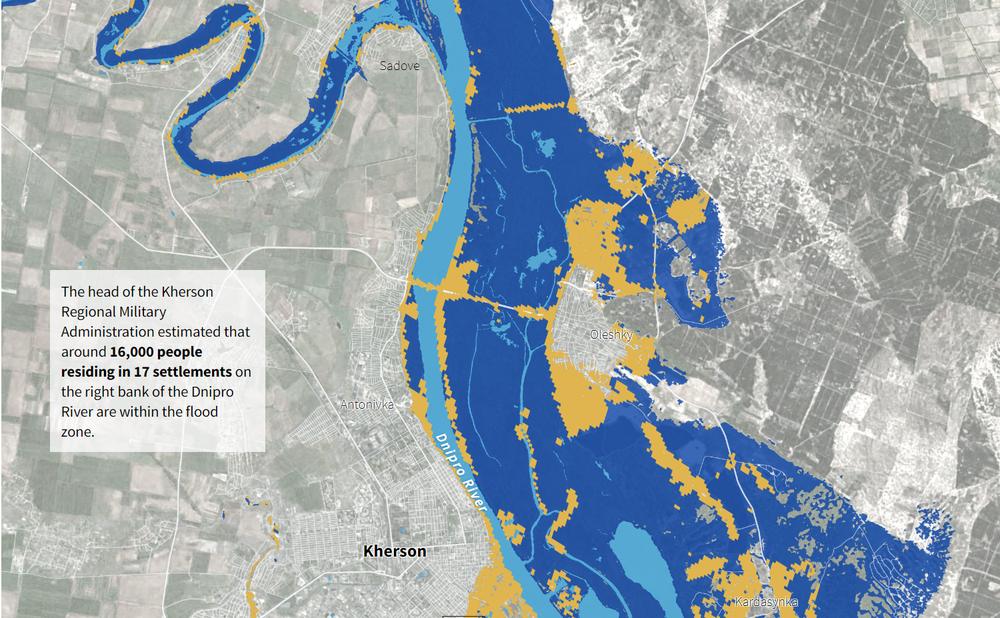
The 2022 invasion turned Oleshky into a "risk node"[cite: 6]. The Kakhovka Dam destruction (June 6, 2023) caused massive flooding, affecting ~100,000 people and causing $14 billion in total damages [cite: 11, 12]. In Oleshky, 63% of the urban zone was flooded at peak [cite: 13]. As of 2026, the population has plummeted from 38,000 to less than 6,000 residents[cite: 20].
Data Sources & Methodology
This report prioritizes: (a) Ukrainian academic encyclopedias [cite: 21]; (b) official government data[cite: 22]; (c) UN systems (OCHA, UNOSAT) [cite: 23, 25]; and (d) WHO/ICRC reports[cite: 23, 24]. Satellite imagery is used as a proxy for the occupied areas where field validation is impossible [cite: 29].
Historical Chronology & Demographics
Medieval Oleshshia
First mentioned in 1084 in the Hypatian Codex, Oleshshia was a vital port in the trade system between Rus and Byzantium [cite: 34, 35]. It served as a key node in the "route from the Varangians to the Greeks"[cite: 36].
Cossack Era: Oleshky Sich
Functioned as an administrative-military center from 1711 to 1728 within the Crimean Khanate [cite: 39]. It represented a phase of Cossack autonomous policy under geopolitical pressure [cite: 41].
Modern Development
Urbanization began in 1784 [cite: 44]. By 1897, the population reached 8,999[cite: 45]. In 2020, the Oleshky Hromada was formed (38,313 people), providing the pre-war baseline for comparison [cite: 52, 53].
War and Occupation (2022–2026)
Oleshky has been occupied since February 24, 2022[cite: 7]. On March 8, 2022, a mass pro-Ukrainian rally occurred[cite: 9]. The destruction of the Antonivskyi Bridge in 2022 isolated the city from liberated Kherson, creating long-term logistics and evacuation barriers [cite: 68, 91].
Kakhovka Dam Disaster & Flooding
The dam's destruction on June 6, 2023, led to a rapid drop in reservoir levels (from 16.4m to 9.04m in 5 days)[cite: 81].
| Oleshky City (AOI ~16 km²) | Peak (June 6–9, 2023) | Post-Peak (June 17, 2023) |
|---|---|---|
| Flooded Area | ~10 km² (≈63%) [cite: 13] | ~3 km² (≈25%) [cite: 14] |
| Affected Structures | 7,979 [cite: 84] | ~1,500 [cite: 85] |
Environmental Impact: UNEP warns of irreversible ecological damage, water contamination, and long-term health risks [cite: 93].
Humanitarian Situation (April 13, 2026)
Population & Evacuation
The Hromada population has decreased by at least 32,313 people compared to 2020 [cite: 100]. Currently, ≤ 6,000 residents remain[cite: 98]. Evacuation is virtually stopped due to lethal risks[cite: 99].
Infrastructure & Healthcare
- Medicine: Only the surgical ward of the city hospital is functional [cite: 103].
- Services: Massive degradation of water, electricity, and sewage systems [cite: 107].
- Access: The UN confirms people are "largely cut off" from protection systems [cite: 108].
Economic Losses (Heuristic Estimate)
While official municipal-level financial losses for Oleshky are not public, a proportional estimate based on the $14B national PDNA suggests local damages could be in the range of $226 million (based on flooded area density) [cite: 147, 151].